90 + 5

It’s almost time to prepare the presentation for next Tuesday. I have to admit I am woefully unprepared in terms of my data and processing this through Eviews. While I have identified the data set as unstructured panel data, I have underestimated the amount of time it will take to process this through. I can use this to my advantage by presenting the question to students in the presentation next week, as to where the data set needs to grow. Luckily, I have the time prepared before the final report is due to present this.

The process itself was enjoyable, and I am glad I picked a topic in the end that is appliciable to my work, but also personally. I have met many people along the way that have given me ideas and alternative perspectives on the topic, and I hope that by finishing this paper that they will be able to have a larger discussion on the topic.

The hardest part of this paper was time management and allowing myself the time to undertake the research. I would of liked to dedicate more time to the report overall, and I believe if I structured my time more efficiently, this would have made for a better outcome and less stress at this point.

I believe that I have learnt not only in the application towards my degree, but also towards my management of projects, presentation of ideas, and investigating topics that run far deeper than anticipated.

For my sake, I do wish there was 5 mintues of extra time.

Post Match Review

I have gathered the appropriate data for each of the variables, including the more difficult to gather distances and income status. The next phase will need to involve serious devotion of time to execute the demands of the project, in addition to understanding key areas of the results.

In preperation for the presentation, further research will need to be conducted on the topic, however many papers will need to be categorized into supporting elastic ticket pricing, or against. Additionally, as many of these papers crossover, it will be important to identify key differences in each.

As I’m reflecting on the work done so far, I’m on a Football Coaching Course in Canberra. Maybe it is just the cool air and the long hours, but it has been difficult to dedicate serious time to the project.

I have been discussing with people on ticket pricing and their perceptions, in hope to understand what they believe to be important factors. While more a more nuanced items are brought up, I am having to draw myself back to the research questions. I believe these need to be defined further to avoid straying from the point of the paper.

Feedback included that my proposal will need to be improved in the literature review, particularly in flow of ideas and the scope of what impacts consumer decisions. The literature review has the linkages to explore more commonplace papers, such as music events and shows, as the similarities are quite similar.

Over the semester, the paper has become more structured in the theory and reasoning. I feel that when the literature review becomes more structed, the results will be easier to explain and the flow of ideas allowing for further discussion.

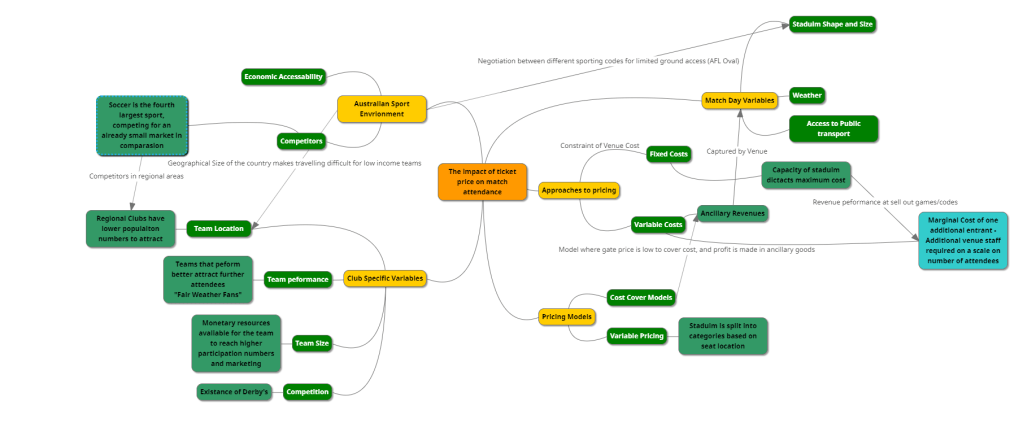
Based on my concept map, linkages across the broader events industry are evident, however the very basic concept map has evolved into more soccer focused flow.

Further work into the concept map based on the literature avaliable will aim to assist in the introduction of ideas, and identify just how linked pricing is throughout all parties involved.

Next Steps:
– Formalise data and equation
– Identify further literature on broader scope to set the scene

Video Assistance Referee – “Beyond Reasonable Doubt”

The buildup to the proposal presentation was one of the more stressful periods of this project; over analysing every slide and sentance to ensure it made sense eventually did more harm than good. It resulted in the theoritical framework of the paper being thrown out and written again – the day before.

I’ve taken onboard a few key messages:
1. Don’t overcomplicate what is already simple
2. Don’t leave it last mintue
3. Back yourself

One of the main feedback points on my presentation was to ensure that there was sufficient reasoning or evidence to make conclusions and justification. While these don’t always have to be correct, its subjective. If you believe its important and can have buy in from your audience, the vision is clearly communicated across.

The next phase of the paper is to complete the review and put the methodology into practice. While everything is easier said than done, I’m looking forward to seeing what is produced and what can be adjusted for the Final Report.

There is just on a month to complete and present the final writing – I’m taking the approach of testing then adjusted on the data set to reach what I hope is the clearest outcome and further discussion on the topic.

Balls, Bibs and Cones

I’ve begin to write up the absract of my research proposal, and found it difficult to keep myself out of it. Using objective language and keeping sentances to the point is much harder than anticipated. The literature currently collected and fitted into the matrix is 14 papers; a wide spread from Concession Pricing, Variable ticketing to VAR models to test mono or bi-laterial causality. Through the mix of these papers, it became increasingly cloudy on what I was focused on. From this, it became clear I have been trying to do to much with little time, in an attempt to work harder, and not smarter.

At this point in time, the research is highlighting intresting points that are not commonly considered with typical products. For example:
– Clubs are not mono product regional monopolists. Clubs can be considered as providing the team on the pitch, but also providing ancillary goods and services, such as merchandise, additional entertainment and match day services
– Willingness to pay is captured through the A-League model of variable ticket pricing; catergorising tickets into A, B and C. A being the most expensive, to C being the lowest ticket price and the minimum a person is willing to pay to watch the match
– Ticket prices for higher categories should be more elastic, while ticket prices for lower categories should be more inelastic.
– By traditional product standards, pricing in the inelastic portion of the demand curve is inefficient, however clubs may not be profit maximising, but focused on winning matches to source additional revenue outside of ticket prices.

Much of this research is found through Silvestri (2017), to which a Two Stage Least Squares model is adapted to find match day and club specific variations in elasticity. For my research, it is important to note that sport in Australia is a large market with many competitors, some with deep historical value. This will need to be acocunted for in the model and if this is not possible, will be a drawback in the report. While many papers look at sports that have existed in the market for a historical time; Major League Baseball in America (aptly named “America’s Past-time”), the 121 year old SerieA competition in Italy; the gap in the Australian football market leaves new ground to be broken on the nature of responsiveness to a sporting competition which by comparasion, is relativly new.

My next steps from here are to begin formalising the process to which the following will be tested against:
For the context of the Australian Football Market, the paper will analyse if ticket prices are important in determining attendance and based on this, if it is justified to price in the inelastic or elastic area of the demand curve.
With the data avaliable, this will be on n=142 on the 2015/16 season of the A-League.

My hope is that with the equipment on offer, the paper will be able to bring to life the conversation of effective pricing of football matches and ability to improve accessibility to match day events.

Next Steps:
– Formalise the Literature Review; additionally find papers on inelasticity on entertainment events
– Begin to shape the variables using data. Obtain additional seasons if possible to create richer data set
– Determine the story the model will tell, and if a split model is more viable in determining results.

Re-Inventing the Ball

With European football back in full swing, and the MLS continuing to provide an entertaining spectacle, my motivation for research and writing is slowly beginning to pick up. To date, I’ve broken down 10 papers into a matrix, however more work needs to be done in exploring more concepts around elasticity modelling and in particular, how sporting clubs build their foundations on revenue. Many of the papers are based on American competitions; Major League Baseball, National Football League and the National Basketball League are all too prominent in these papers. Understandably, many of the writers are based in America and with population, market cap and information available, it is easier to access the information to write on each topic. I must be conscious that the competition I am looking at is much smaller, and therefore many variables listed in papers may not be relevant or easy to measure. The papers and articles I have read so far are beginning to shape the fundamental question I want to work towards. Elasticity and attendance are both common but can be explored quite differently. Given the information available, time constraints and my own limitations, I believe exploring attendance as the key focus will be more effective. Many papers collected on elasticity are written over the course of some time, and by a group. While effective and informative, I would not be able to devote the same amount of time and dedication to the topic. In addition, there may be scope to expand the topic to elasticity, dependant on what is found within explain attendance through independent variables. I am learning new self-management skills in balancing all the requirements with work and lifestyle, however the topic being of personal interest has made it slightly easier to start the process. However, I believe that in order to present the final paper, I may not need to try and re-invent the ball, but simply learn how to strike it as is.

Next Steps:
– Investigate further resources on Inelastic pricing and linear regression. Complete Matrix.

– Directly define the question

– Draft a concept map of approach towards the question and key resources required.

Humble Beginnings

I will be conducting my research on the attendance of A-League matches, as dictated by a number of variables. This will include ticket price, and potentially include variables on venues, per capita income, team performance and/or new variables that can be measured accurately and are significant to the prediction of attendance. Questions around this topic include:
– What are the variables that drive match attendance?
– What is the appropriate pricing method to maximise profits?
– What are variables that cannot be captured through measurement, but may hold significance?

I found myself to be significantly overwhelmed with the amount of information available on this topic. While beneficial to understanding the scope of the topic, it has been difficult to filter through relevancy and meticulous wording to find true understanding and meaning; what can I apply to my own research.

I have chosen this topic as it appeals to me on a number of factors. Firstly, and most importantly; it relates to my currently employment in football. While there may be speculation as to conflict of interest, it is a widely discussed topic of the cost of football, both relating to fan engagement and grassroots participation. I seek to clarify and dig deeper so as to provide more discussion to effective pricing and further meaning behind the numbers. My unique position also gives me access to parties involved, context and clarification on why items are priced and information gathered. Secondly, football is a personal passion of mine. I believe to write a topic within a strict deadline, one has to be engaged enough to drive through for results. Finally, the articles and literature that currently exist are targeted towards American competitions. While I have found some papers in relation to international competitions such as the Serie A (First Team Italian club football – see reference list below), I believe it is important to recognise the commercial potential that may not be captured, and also beneficial to the new emerging A-League clubs.

While it is a large mountain to club, my unique position provides access to resources that would otherwise be difficult to attain. I seek to use this opportunity to its full potential and provide a comprehensive report within the given timeframe. I anticipate there to be many challenges, particularly around availability of data and creating the regression to be robust and thoroughly tested. I will need to begin reviewing previous work completed in ECON339 to ensure that I am across using analysis, EVIEWS and interpretation of results. To begin this process, I’ve included some beginning literature below:

– Can We Find It at the Concessions? Understanding Price Elasticity in Professional Sports (Krautmann and Berri, 2007); This paper seeks to understand the relationship between inelastic ticket pricing and elastic demand of stadium goods and services. 

– Ticket Pricing Per Team: The Case of Major League baseball (MLB), (Lee, Park and Miller, 2013); The conclusions drawn through Error Correction Model (ECM) determined there are specific team factors that impact attendance, however overall, attendance was inelastic to pricing. 

– Variable Ticket Pricing in Major League Baseball, (Mark and Matt, 2007); Mark and Matt hypothesised that different times of the year and themed rounds (Memorial round and Independence Day) with variable ticket pricing brought in further revenues for clubs. The difference identified between fixed and variable tickets was 2.8%. This was adjusted on capacity constraints. 

– Ticket Pricing, Concessions and Attendance at Professional Sporting Events, (Coates and Humphreys, 2007); This paper explores three codes, Major League Baseball, National Football League (American Football) and National Basketball League. Similarly to the above, prices are determined to be inelastic with the notion that codes have the ability to hold monopolies in markets; revenue is maximised when prices are determined from inelastic areas of the demand curve.

– Optimal ticket pricing in the sport industry. The case of the Italian Serie A, (Silvestri, 2017); Clubs are regional monopolists, and market power arises from fan loyalty. This paper also confirms, as common in the above papers, that the Marginal Cost of selling additional tickets is zero, thus prices falling within the inelastic area of the demand curve. The paper literature review explores the idea of tickets providing the right to consume in the event as well as attend, bringing attention to ancillary revenue. It is reviewed that prices to tickets are lowered to that of the optimum, so the attendees are enticed to consume at the staduim.

Next Steps:
– Compile Literature into Excel matrix
– Begin to create potential regression
– Source meaningful and robust data

Additional Reasource: LaTrobe University – Inelastic Pricing ( https://www.youtube.com/watch?v=-mv9-TqHnKc )